October 26, 2026 · 2 min read
Why clear blue-light glasses don’t help you sleep
Most “blue light” glasses are clear, and clear lenses stop short of the colour your body clock actually reads. Here is what the research says, and what does work.
Here is a strange fact about the most popular sleep accessory of the last decade: most “blue light” glasses barely block blue light. When researchers at the Hong Kong Polytechnic University measured popular blue-filtering spectacle lenses, they cut only about 10 to 24% of blue light (Leung et al., PLOS ONE, 2017). The rest walks straight through.
Your body clock doesn’t read “blue”. It reads 480 nm.
Deep in your retina sits a light sensor most people have never heard of: melanopsin. It isn’t there to help you see. It is there to tell your brain what time it is. Melanopsin is most sensitive to blue-green light around 480 nanometres (Lucas et al., Trends in Neurosciences, 2014), and when it fires, your brain reads “daytime” and holds back melatonin, the hormone that makes you sleepy.
Clear lenses mostly trim violet and deep blue, roughly 400 to 450 nm. That’s like closing the front door and leaving the garage wide open: the band your body clock actually listens to, around 480 nm and into the green, gets through untouched.
Clear lenses are built for glare. Night lenses are built for your body clock. They are not the same product.
What the studies on amber lenses found
Amber lenses are different because they block the whole blue-green band, not just the violet edge. In a randomised trial, people who wore amber glasses for three hours before bed reported better sleep quality and mood than people given yellow placebo lenses (Burkhart & Phelps, Chronobiology International, 2009). A small 2018 trial in people with insomnia found the same pattern: amber lenses worn two hours before bed for a week improved sleep compared with clear lenses (Shechter et al., Journal of Psychiatric Research, 2018).
And clear lenses? A 2023 Cochrane review of blue-light filtering spectacles found they probably make little or no difference to eye strain, and the evidence for sleep was too weak to call (Singh et al., Cochrane Database of Systematic Reviews, 2023). Which matches the physics: if a lens leaves 480 nm alone, there is little reason for it to change your evening.
The myth: “any orange tint will do”
Colour alone tells you very little. Plenty of cheap orange glasses have the tint sprayed on as a surface coating, which thins as it scratches, and many let part of the green band through. What matters is the number: how much light between 400 and 550 nm the lens actually stops.
How we built Noctis
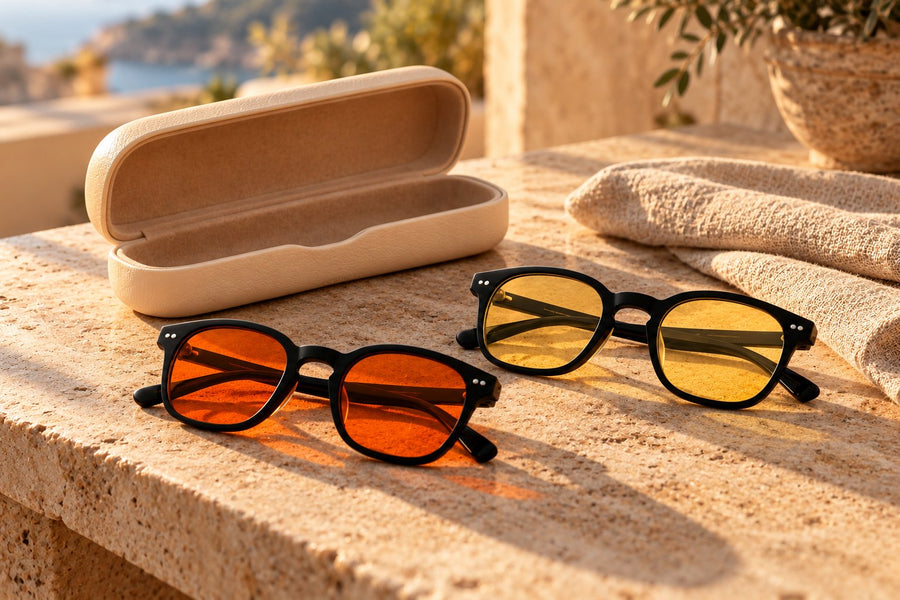
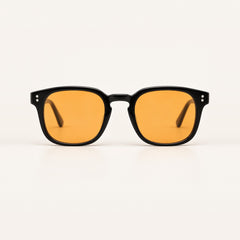
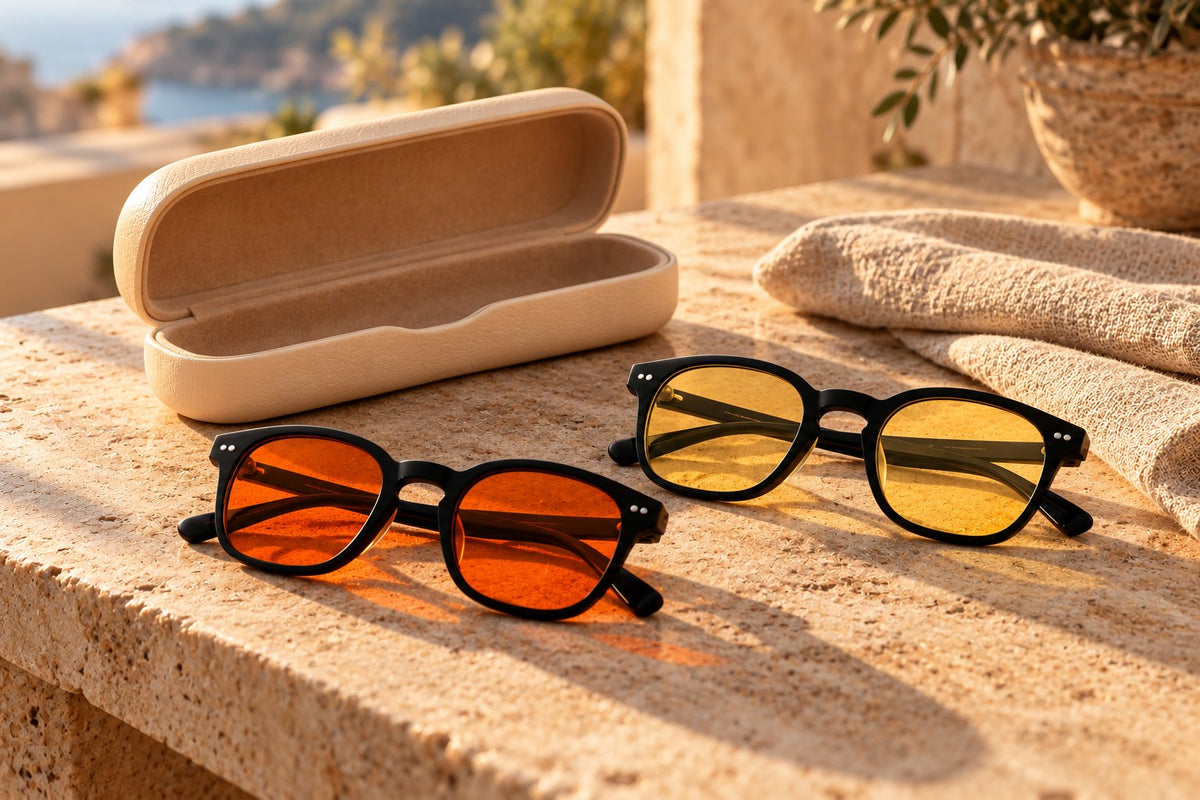
Noctis night lenses are rated to block 99% of light from 400 to 550 nm, blue and green, with the amber in the lens rather than on it. Every pair ships with a blue-light test card, so you can shine a light through and see the block for yourself on night one. For the hours at your screen there is Sol, a pale yellow day lens that takes the edge off harsh blue while keeping colours readable.
The routine is simple: Sol for the day, Noctis for the last two hours before bed. Wear them for 30 nights. If you aren’t sleeping better, send them back.
Sources: Leung TW et al., PLOS ONE, 2017 · Lucas RJ et al., Trends in Neurosciences, 2014 · Burkhart K & Phelps JR, Chronobiology International, 2009 · Shechter A et al., Journal of Psychiatric Research, 2018 · Singh S et al., Cochrane Database of Systematic Reviews, 2023.